Does Google Penalise AI-Written Content? What Google Actually Says
Aditya Sharma
- 9 min read
You let an AI tool draft a post, and now a worry follows you around: will Google treat the whole site as spam? It is a fair worry. Advice online runs from “Google bans AI content” to “Google cannot tell the difference”, and most of it never quotes Google.
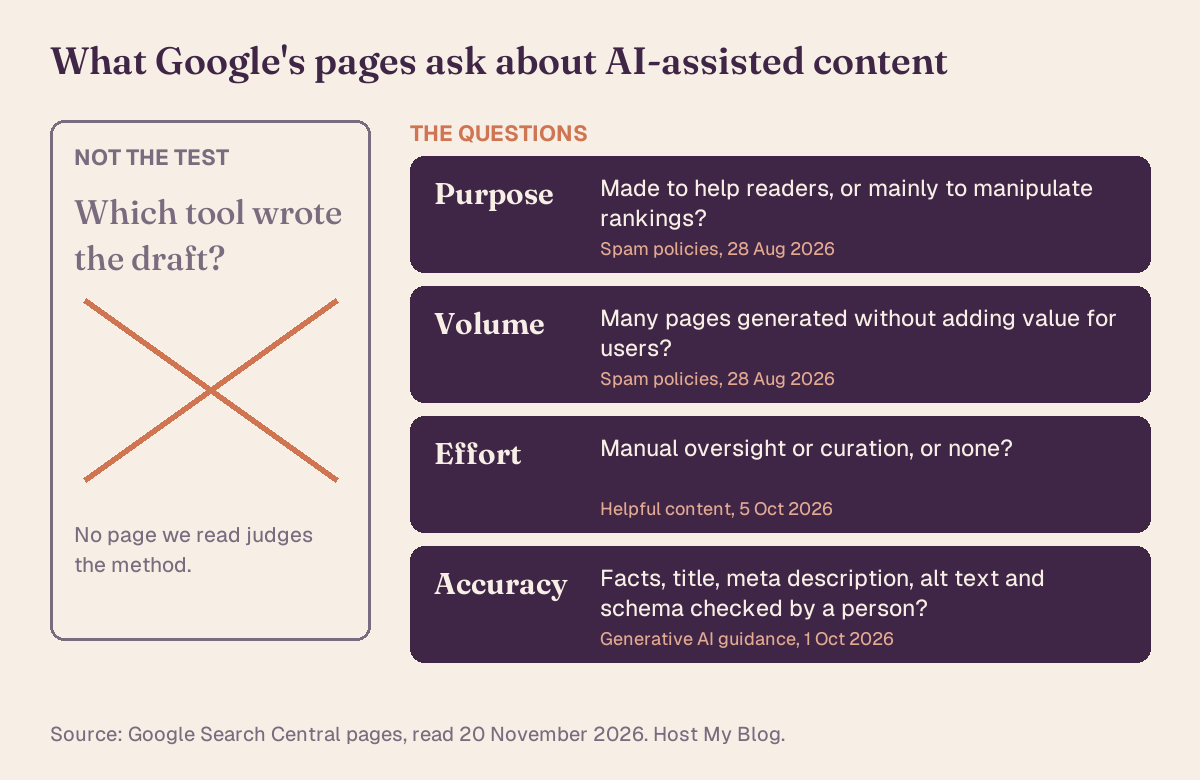
So we read Google’s own pages. The short answer is that Google does not penalise content for being written with AI. It acts against content made mainly to manipulate rankings instead of helping readers, and it says so about content “no matter how it’s created”. AI becomes a problem when it is used to produce many pages without adding value. That is a question about purpose, volume and checking, not about the tool.
This post sets out what four Google pages say, what counts as a problem, the checks Google asks for before you publish, and what nobody outside Google can tell you. We read every page on 20 November 2026 and give the date each page shows.
What Google’s own pages say about AI content
| Google page | What it says | Date shown on page |
|---|---|---|
| Spam policies | Lists “using generative AI tools or other similar tools to generate many pages without adding value for users” as an example of scaled content abuse. | 28 Aug 2026 |
| Guidance on generative AI content | AI “can be particularly useful when researching a topic, and to add structure to original content”. Also: “It is critical to manually factcheck and review all AI-generated content for accuracy and trustworthiness before publishing.” | 1 Oct 2026 |
| Creating helpful content | Using generative AI “to produce large amounts of text without manual oversight or curation represents little to no effort”. | 5 Oct 2026 |
| Optimizing for generative AI features | Unique, useful content will “likely influence your website’s presence in generative AI search in the long run more than any of the other suggestions in this guide”. | 10 Jul 2026 |
None of these pages says content is demoted because an AI wrote it. Each judges what the page does for a reader: how much effort and originality went in, whether the facts hold, and why the page exists. The spam policy describes the enforcement side plainly. Google detects violations “both through automated systems and, as needed, human review”, and sites that violate the policies “may rank lower in results or not appear in results at all”.
We also searched those pages and Google’s AI features page for the word detector. None of the five mentions one. That does not prove Google has no way to spot AI text, but it means an AI detector score is not a measure Google gives you, and no page tells you to chase one.
What counts as a problem
The spam policy defines the term: “Scaled content abuse is when many pages are generated for the primary purpose of manipulating search rankings and not helping users.” Its examples include generating many pages with AI tools without adding value, scraping or stitching together content from other pages, and creating many pages where the content makes little sense but contains search keywords.
Notice the phrase “no matter how it’s created”. The rule applies to thin pages written by hand just as it does to generated ones, and nothing in the definition is specific to AI. Our reading is that the generative AI example is in the list because AI makes volume cheap. Google does not say so.
Here are two illustrative cases, not real sites.
- Case one. A food blog publishes three posts a week. The author drafts with an AI tool, then adds their own photos and test notes, corrects the quantities and publishes. Nothing in the pages we read describes that as scaled content abuse.
- Case two. A site generates 400 pages over a weekend from a keyword list and publishes them unread. That matches the first example in the spam policy: many pages, generated with AI, with no value added for users.
Google also gives you questions to ask yourself. The helpful content page asks “Are you using extensive automation to produce content on many topics?” and “Are you mainly summarizing what others have to say without adding much value?” If either answer is yes, the tool is not your problem. The plan is.
What Google asks you to check before you publish
The generative AI guidance explains why review matters: “generative models don’t retrieve facts, but predict a likely sequence of words based on their training data.” Their output can contain inaccuracies, which Google calls hallucinations. The review duty also covers the parts of a page that readers rarely read. Google names title elements, meta descriptions, structured data and image alt text, all of which “can appear in Search results”.
Structured data needs a second look, because markup must also follow Google’s own policies for each feature. If you generate schema with a tool, validate it. Our comparison of schema validators shows what each one checks.
The table below turns the guidance into six checks you can run on any AI-assisted draft.
| Check | What to ask | Where Google says it |
|---|---|---|
| Facts | Can you source every claim, number and date in the draft? | Guidance on generative AI content: “manually factcheck and review”. |
| Metadata | Did you read the title, meta description, alt text and structured data the tool wrote? | Same page: the review “also applies to metadata”. |
| Added value | What does this page hold that the top results do not: your test, your photo, your data? | AI features guide: do not “just recycle what others on the internet have already said”. |
| Authorship | Is there a real byline, and is every author profile real? | Helpful content: fabricating profiles with “AI-generated headshots, made-up names, or false credentials” is “a form of deception”. |
| How it was made | Would a reader reasonably ask how this was produced? If so, say so. | Helpful content: disclosures “are useful for content where someone might think ‘How was this created?'” |
| Purpose | Is the page made to help readers, or mainly to attract searches? | Helpful content: “Is the content primarily made to attract visits from search engines?” |
Here is the same list in a form you can paste into a publishing checklist.
Before publishing an AI-assisted post
[ ] Every claim, number and date checked against a source
[ ] Title, meta description, alt text and schema read by a person
[ ] One thing in the post that the top results lack
[ ] Real byline; no invented author profile
[ ] A note on how AI was used, if readers would ask
[ ] Written to help readers, not only to catch a query
Three claims about AI content, checked
| Claim | What the Google pages say | What we can and cannot say |
|---|---|---|
| “Google spots AI text and demotes it.” | The pages we read describe enforcement against spam practices, found by “automated systems and, as needed, human review”. None describes demotion by writing method. | We can say Google judges practices and value. We cannot say how Google detects anything, and nobody outside Google can. |
| “A disclosure makes AI content safe.” | Disclosures “are useful” where readers would ask how content was made. | A disclosure adds context. It does not replace value or fact-checking. |
| “Any AI help is risky.” | AI “can be particularly useful when researching a topic, and to add structure to original content”. | Using AI for research or structure is described as useful. The stated risk is volume without value. |
What we do not know
Google gives no number for how many AI-assisted pages count as “many”. It publishes no detection method. It also does not say that a site with a few weak AI-assisted posts will be treated like a site that generated hundreds.
The guidance points to the Search Quality Rater Guidelines, sections 4.6.5 on scaled content abuse and 4.6.6 on content made with little effort. Google adds that those guidelines “are not a guide to ranking first in Google” and that raters’ “ratings don’t directly influence ranking”. Treat them as a description of what Google considers low quality, not as a scoring sheet.
We have not run an experiment for this post. It summarises Google’s documentation as it stood on 20 November 2026. Google updates these pages, so re-read them before you change a workflow.
Where Host My Blog fits
RankReady is our WordPress AI SEO plugin, and it runs alongside Yoast, Rank Math, AIOSEO and SEOPress. It can draft a summary and FAQ for a post using an AI provider you connect with your own key. Google’s advice applies to that text as much as to your article: read it, check the facts and fix it before it goes live. Our own review checklist is in AI-Written Summaries and FAQs: What a Human Must Check Before Publishing.
RankReady’s documentation states that it “does not change your post body”. It adds machine-readable versions alongside the post. Pro adds generation on publish and in bulk, which creates more text that nobody has read yet, so the review step matters more there, not less. See the RankReady page for what each tier does.
Questions people ask
Does Google penalise AI content?
Not for the method alone. Google’s spam policies target pages made mainly to manipulate rankings, however they were created. Using AI to generate many pages without adding value for users is a named example, so the risk comes from volume without value, not from AI use.
Do you have to tell readers that a post used AI?
Google does not say every page needs a label. It says disclosures are useful where readers might ask how content was created, and it asks you to consider adding background on how automation was used. For product feeds, Google Merchant Center has separate rules for AI-generated images and product data.
How many AI-assisted posts is too many?
Google gives no number. The spam policy talks about purpose, and the helpful content page asks whether you are using extensive automation to produce content on many topics. Judge each post by the checks above, not by a quota.
Can you use AI for summaries and FAQs on your own posts?
Google’s guidance covers all generated text and metadata, including structured data, so the same review applies. Note that Google no longer shows the FAQ rich result, which we cover in Google removed FAQ rich results.
If a reader asked how your last five posts were made, could you show them the facts you checked?
Aditya runs Host My Blog and writes The Cited. Five years in WordPress, most of it spent on what actually makes a blog get found rather than what is supposed to. His attention now goes to how AI answers are changing that, and what a blog has to do to still be the source people land on. Everything he writes about here gets tested on the blogs Host My Blog looks after before it reaches the page.
More in AI Search
Search Console’s Generative AI Report: What It Shows, What It Cannot and the 9 to 11 November Logging Error
Google lists a logging error that lowered impressions in the Generative AI report for 9 to 11 November 2026, so this post explains what the report shows, what i
Read an nginx or Apache Access Log for AI Crawler Traffic, Properly
Your access log already knows which AI crawlers visit and what they get refused. Here is how to read it without misleading yourself.
Find Your Stale Posts: A Script That Ranks Your Archive by Age
A script that ranks your whole archive by staleness using the WordPress REST API, and a way to decide what to update and what to leave alone.

No comments yet
Be the first to comment.
Write a comment