The Cited #2: Where Your Readers Really Come From
Aditya Sharma
- 6 min read
Open the stats page you already check, whether that is Google Analytics, Jetpack or your host’s dashboard. Find the list of where your readers came from last month. It takes about a minute.
Search, Pinterest, Facebook, email, people typing your address. Keep that list open, because we are about to put a real one next to it.
Most of us know our top post. Far fewer of us know our top source.
Welcome to issue two of The Cited. In the last issue, Search Your Own Blog Name, and Meet RankReady, I introduced it and looked at what happens to your clicks when Google shows an AI answer. Thank you for reading it.
The Cited is a short note from Host My Blog for people who run a blog, food or otherwise. Each issue has one number, the news worth your minute, and one small thing about whether AI can read your blog. This page is the longer version, with the charts and every source. You can also get it in your inbox.
This time: one number on where readers come from, seven headlines worth your minute, and a quick way to see whether AI can read your blog.
One number to hold onto
6.76% of Pinch of Yum’s visitors in March 2026 arrived from email. Two years earlier it was 3.9%.
Pinch of Yum is one very large food blog, and Food Blogger Pro published its traffic breakdown on 30 April 2026. So this is one blog’s own numbers, a picture and not a promise for yours.
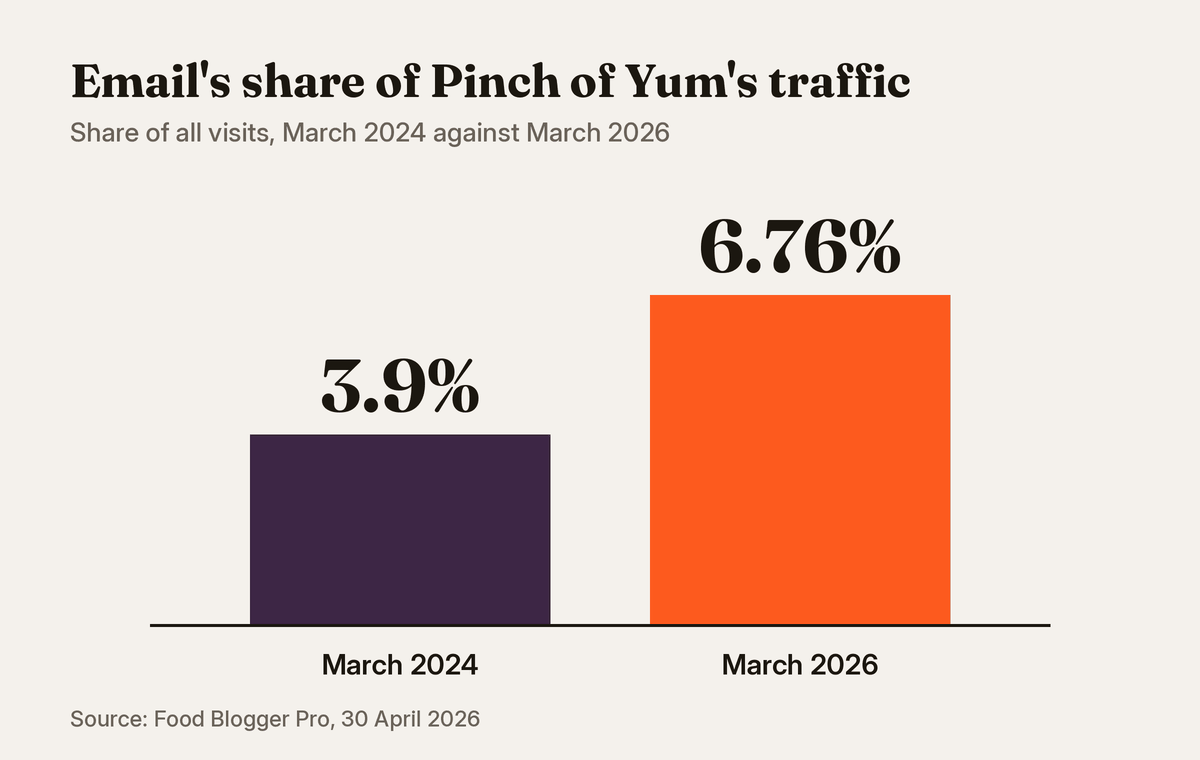
That is close to double. Email is the one source on this list you own outright: your list, your timing, and no algorithm between you and the reader. That is Food Blogger Pro’s point, and it is why the number is worth holding.
It is not only you
One blog proves nothing about yours. It does show where a shift can hide. Here is the same breakdown for the six biggest sources, March 2024 against March 2026.
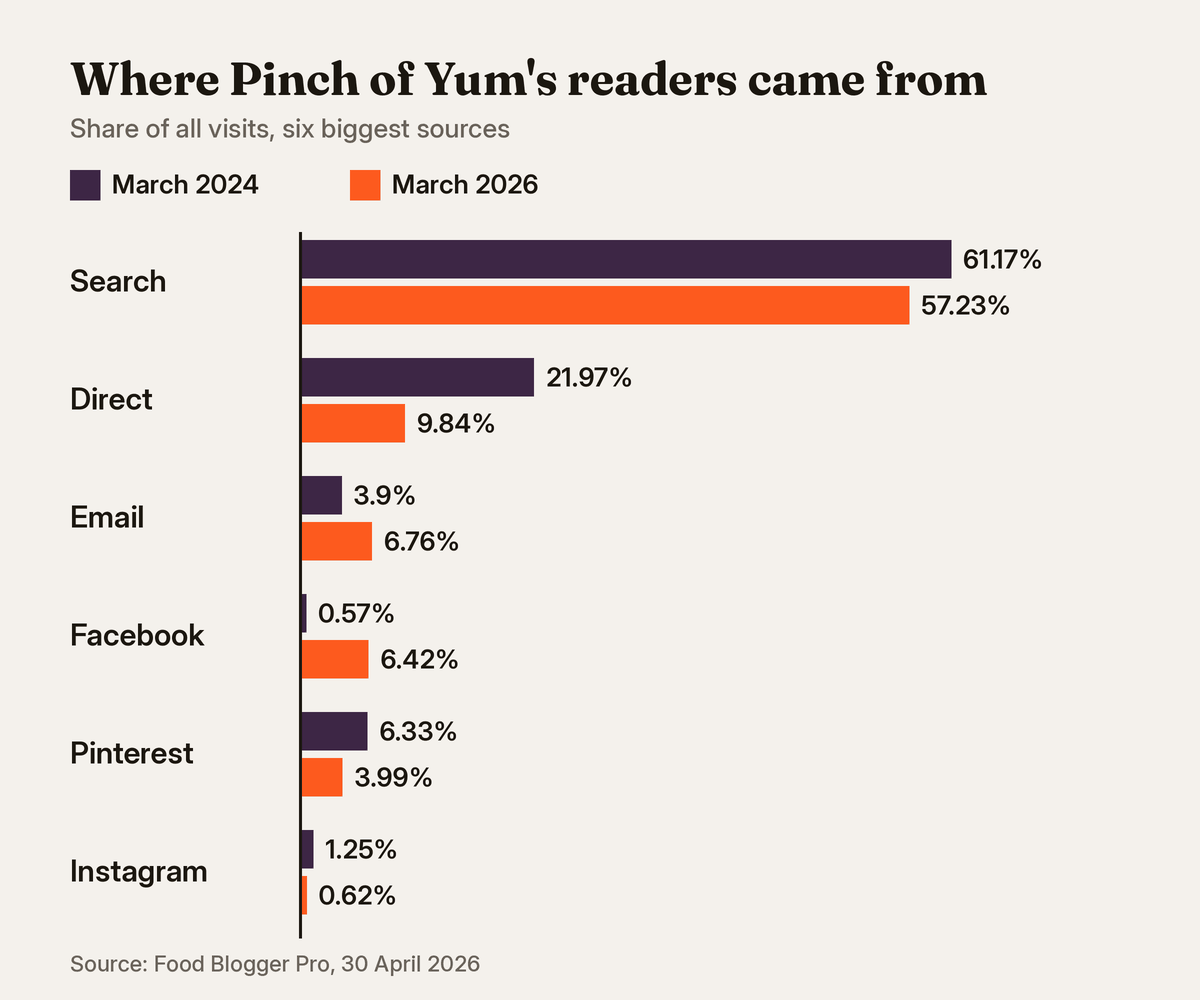
- Search is still the biggest source by far, 61.17% down to 57.23%.
- Direct traffic, visits with no clear source, fell from 21.97% to 9.84%. That is the biggest move on the list. Food Blogger Pro’s read is that readers did not stop caring. They come back through email, search and social instead of typing the address. Some of it may also be how visits get labelled, which I cannot check from here.
- Facebook rose from 0.57% to 6.42%. Food Blogger Pro says Pinch of Yum began prioritising Facebook in the last quarter of 2025 and posts there three times a day.
- Pinterest slipped from 6.33% to 3.99%, and Instagram from 1.25% to 0.62%.
Add search and direct together and you get 83.14% in March 2024 and 67.07% in March 2026. That sum is mine, from the two rows above. It fits Food Blogger Pro’s summary that traffic now comes from more places than it used to.
If your own numbers have shifted between sources this year, you are in good company. It is a shift in the route, and it does not have to mean fewer readers.
Why is this interesting?
Because Google’s Search Console shows you only one of those sources: search.
It is still the biggest one, and it is where new readers find you. Your best three posts are your front doors. They show which questions readers bring you and how they like them answered, whether you write about food, travel or anything else. The Pages tab in Search Console’s Performance report lists them.
So here is the question worth holding: which of your own posts do readers actually arrive on? The email row on a chart like this one is made of people who once landed on a post and found a way to hear from you again.
Worth knowing this week
Seven headlines, each linked to the original, with a line or two so you can decide in a minute whether to read on.
Google’s September spam update is rolling out and may take up to two weeks
If your traffic wobbles before it ends, note the date and leave your posts alone. Search Engine Journal, 24 Sept
Chartbeat: Google search visits to publishers fell 40% in a year
Mostly news sites, so it is a direction and not your number. Readers who visit often held steady. Search Engine Journal, 24 Sept
Google is testing a “Dive deeper” button in Discover
It shows an AI overview with links instead of opening one article. It starts with videos and is only a test. Search Engine Roundtable, 18 Sept
AI Overviews carry more links, but not every link reaches a website
One analyst filmed a link inside the answer that opened another Google AI chat instead of a page. Search Engine Journal, 25 Sept
Search Console now shows searches that started with a photo
Lens and Circle to Search get their own filter, with pages only and no search words. Worth a look if photos are your draw. Search Engine Journal, 24 Sept
AdSense now asks for identity verification before ads start
Google dropped the threshold to $0. Depending on your country, keep a photo ID handy, and you may be asked for a video selfie. Search Engine Roundtable, 23 Sept
Google added ad metrics to its page experience guide, but not as a ranking factor
Chrome now reports how many ads your pages show, and how heavy. Google’s John Mueller says not everything is a ranking factor. Search Engine Roundtable, 22 Sept
Now the other half. Is your site AI ready?
Everything above is about people finding you. ChatGPT, Perplexity, Claude and Google’s crawlers read blogs too, and whether they can read yours is a separate question from whether your posts rank.
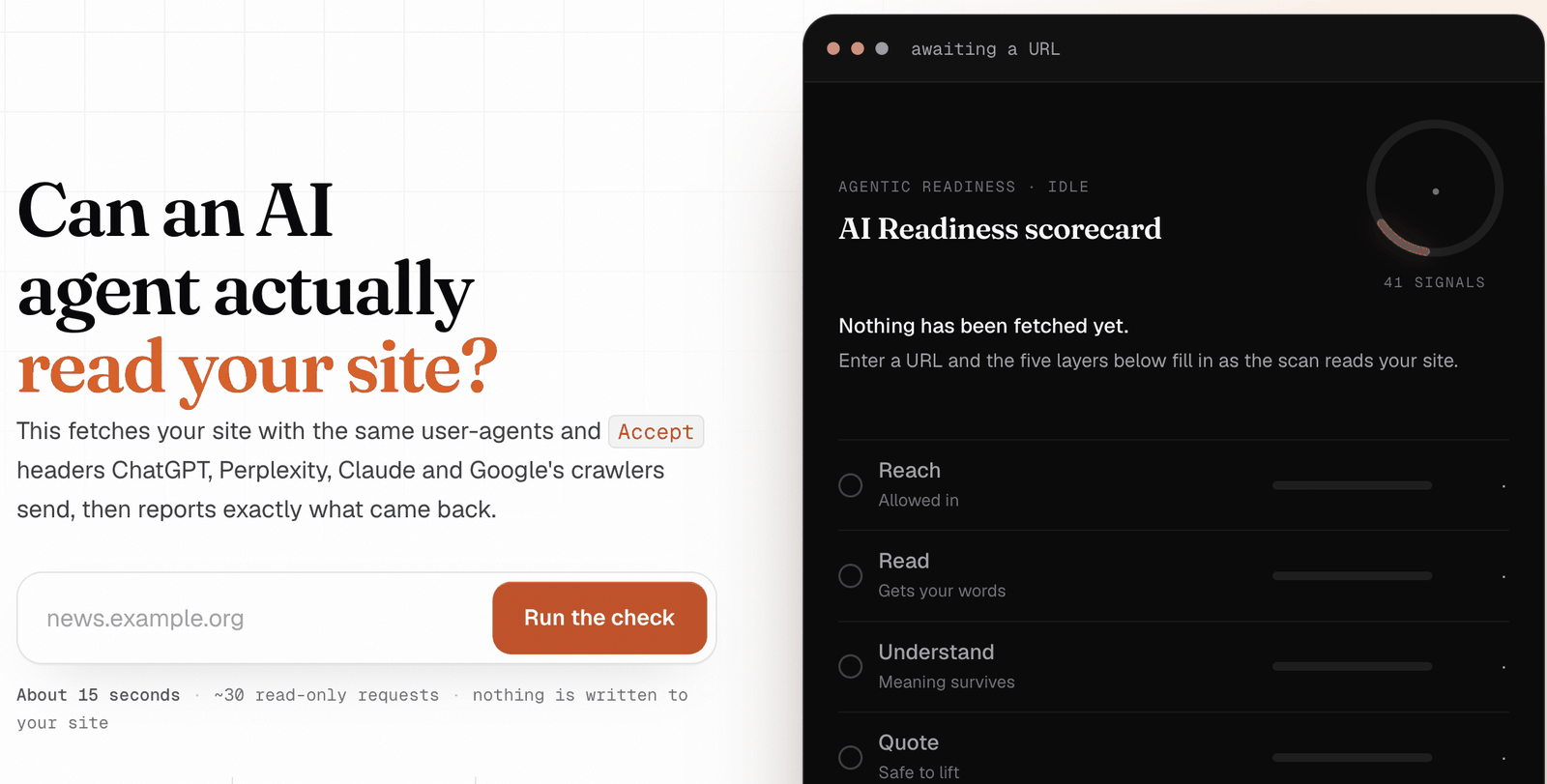
Find out in about 15 seconds
We built a free audit tool for it, the AI Readiness Checker. It takes about 15 seconds, needs no account, and reads your site the way ChatGPT, Perplexity, Claude and Google’s crawlers do.
And if it finds gaps
You can fix them with RankReady, our free WordPress plugin. Install it if you like. It works alongside Yoast, Rank Math and AIOSEO and will not fight them. The documentation walks through each setting.
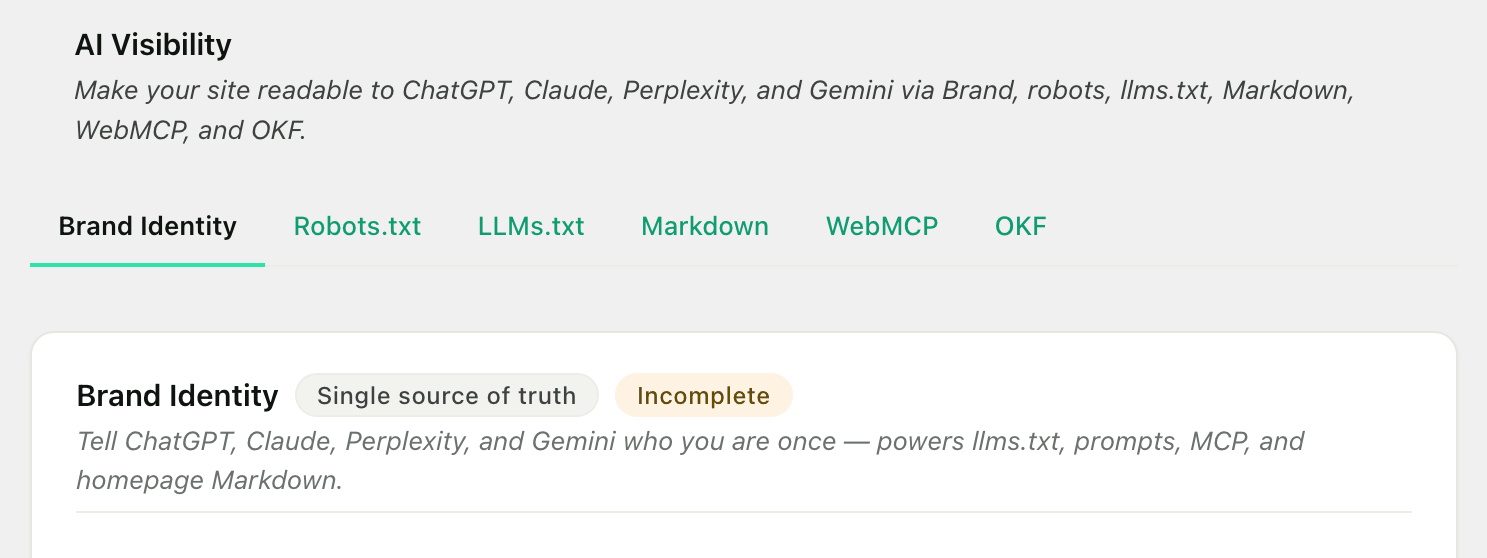
The honest limit: RankReady cannot promise rankings or citations. It helps AI read your site.
The bit at the bottom
So in short: readers keep moving between doors, Google keeps changing what it shows, and it pays to know whether AI can read your blog.
If you want help with anything in particular, just hit reply on the email, or write to support@hostmy.blog. And if a friend runs a blog, The Cited is here.
Warmly,
Aditya Sharma
Host My Blog
Aditya runs Host My Blog and writes The Cited. Five years in WordPress, most of it spent on what actually makes a blog get found rather than what is supposed to. His attention now goes to how AI answers are changing that, and what a blog has to do to still be the source people land on. Everything he writes about here gets tested on the blogs Host My Blog looks after before it reaches the page.
More in The Cited
The Cited #10: How to Check Your Blog in Web-Only Search Results
Search is testing plain results views again. A 10 minute check of three queries in two views shows whether a reader can find your blog in a plain list of links.
The Cited #9: Why Your Visitor Numbers Rarely Match, and Why That Is Fine
Why Search Console, your analytics and your server logs rarely match, and a 15 minute test that shows how far apart they are on your own blog.

The Cited #8: From Being Found to Being Named
A new question for bloggers, one thing to test this week, and eight news items worth your minute.

No comments yet
Be the first to comment.
Write a comment